

Designing Strategy: Framing the Problem (Social Strategy Primer Part IV)
How to understand and frame strategic problems

In the previous installments of the Social Strategy Primer series, we have examined the history and tradition of strategy, defined social strategy as a discipline, and introduced the instruments of social power. These articles set the intellectual foundation for the work ahead—designing social strategies.
Now, we will shift our focus away from talking about what social strategy is and begin talking about how social strategy is made. Building on frameworks inherited from grand strategy, we will learn to employ and align the instruments of social power to allow social actors to effect meaningful change in the world.
— Blaine Worthington, Executive Director
1. Identifying the Strategic Problem
The first step in any strategy is to isolate the problem the strategy is meant to solve or mitigate. While this is a seemingly simple task, there are nuances that can make or break the strategy one seeks to design.
What is a strategic problem? A strategic problem is a persistent, system-level condition that requires coordination among multiple stakeholders with overlapping interests to maintain or alter, and that cannot be resolved through isolated or short-term actions. Let’s examine this definition more closely.
The first thing to note is that a strategic problem is a condition of a complex system that must be either maintained or altered. It is natural to understand a problem as inherently something to be solved, but it is more helpful to think of a strategic problem as a condition to be solved for—either a positive condition to be maintained or a negative condition to be remedied.
For example, a business that is a leader in its field is not free of strategic problems. Rather, its strategic problem is one of maintenance—how do we maintain industry leadership in the face of new technologies, market dynamics, or industry challengers? Industry challengers, on the other hand, have strategic problems of alteration—how do we gain market share from incumbents?
The second thing to note is that strategic problems require coordination among multiple stakeholders with overlapping interests.
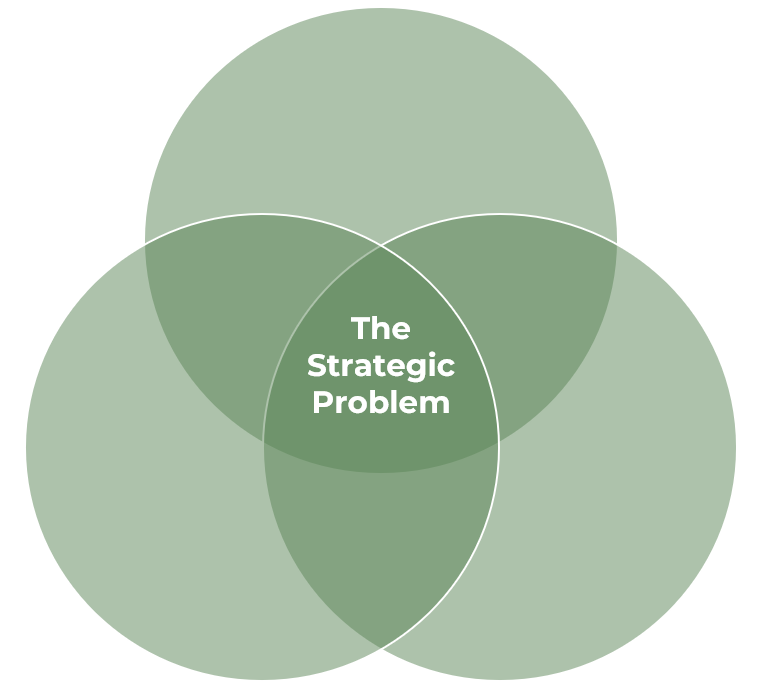
These interests can intersect in complex ways, with some actors’ interests more or less aligned with others. Some actors’ interests may be inherently opposed to one’s own. Yet regardless of the nature of this overlap, strategic problems exist in the equilibrium of a system’s internal tension. They are emergent properties of multiple, independent actors pursuing their own interests and reacting to the others doing the same.
This leads to the final essential component of the definition of strategic problems: they cannot be resolved through isolated or short-term action. Because strategic problems emerge from the complex interplay of actors pursuing their own interests, short-term or unilateral actions often fail to substantively alter the nature of the existing equilibrium. In fact, strategic problems are ontological outcomes of individual actors’ prior isolated or short-term actions. Therefore, deliberate, coordinated action by the existing interested parties is required to move the system to a new, preferable equilibrium.
When we have identified a problem that meets this definition of a strategic problem, we have identified a problem that necessitates a strategy to resolve it. And because strategic problems emerge from the broader system itself, the very act of understanding whether a problem is strategic is already the first step in analyzing the strategic environment itself, which we will discuss next.
2. Understanding the Strategic Environment
The first substantive element of a written strategy is an analysis of the strategic environment. The strategic environment is the complex system of incentives, structures, and external forces that produce a strategic problem and constrain the behavior of the actors in the system. Understanding the strategic environment from which the strategic problem has emerged is critical to designing a strategy that will sufficiently reshape that environment to produce our desired outcomes. To undertake this analysis, we will center our focus on the problem itself, then work outward to analyze the behaviors of actors in the system and how those behaviors have been shaped by past and existing incentives, structures, and external forces. Once these elements are understood, we then must make an informed forecast about the future and what is likely to occur should no action be taken. This structured analysis allows us to identify which elements of the environment must be preserved, which must be altered, and which are likely to resist change.
Step 1: Describe the Strategic Problem
The first step for analyzing the strategic environment is to describe the conditions that comprise the strategic problem. This portion of the analysis should answer the following questions:
What is the nature of the problem?
Where is the problem centered and where is it felt?
Who is impacted by the problem and how?
How has the problem developed over time?
Overall, this portion of the analysis should articulate the scope and scale of the problem and why it either cannot or must (in the case of a positive strategic problem) remain this way. We are answering the who, what, where, and when of our strategic problem, describing the problem as a system condition rather than a lack of action or failure of implementation.
Step 2: Identify System Dynamics that Produced the Strategic Problem
With the problem clearly defined and scoped, we must then understand how the strategic problem came to be. This requires an understanding of the historical context of the problem. Questions to be answered here include:
Who are the relevant actors in the system?
What specific decisions and behaviors by these actors have exacerbated, mitigated, or had no impact on the problem?
In answering these questions, we are focusing on how the current equilibrium emerged, focusing on actors in the system and respecting their agency. The strategic problem is the result of real choices by real people that, deliberately or not, have had the net effect of producing our strategic problem.
Step 3: Identify the Incentives, Structures, and External Forces the Actors Are Responding To
Once we have identified the relevant actors within the system and how their decisions and behaviors have produced the present condition, we must then analyze why they decided and acted the way they did. In conducting this analysis, we must accept that system actors have been acting under conditions of bounded rationality—that is to say that they have been making satisfactory rather than optimal decisions to achieve their aims given their particular understanding of the system and the real-world constraints of time, energy, money, and other resources that could be applied to the decision-making process. Their choices make sense within the incentive structures and constraints of the system—and it is these conditions that we must now examine.
This can pose a particular challenge to the strategist because it requires us to step into the worldview of other people—often people who we disagree with, who have interests counter to our own, or who have acted in ways we would not have given the benefit of hindsight. Even when their actions seem counterproductive or harmful from our perspective, we must make the attempt to understand these actions as rational from their perspective.
Often, harmful or counterproductive behaviors persist because the system inadvertently rewards them. By understanding the incentives, structures, and forces that make actors’ behaviors rational, we will be able to identify which of those conditions must be altered to change the system’s trajectory. To achieve this level of understanding, we must attempt to answer these questions:
What are the actor’s primary goals?
What incentives motivated the selection of these goals?
When actions exacerbate or ignore the strategic problem, what cost/benefit analysis has an actor made that has led them to accept the strategic problem?
What constraints—real or perceived—limit the actor’s ability to assess problems or decisions?
What is the actor’s time horizon, and how does it shape decision-making?
What is the nature of the regulatory or policy structures that govern the system?
How do these structures incentivize or fail to disincentivize behaviors that exacerbate, mitigate, or ignore the problem?
What external forces are acting on the system? (Note: these can be political events, market shocks, meteorological or ecological forces, cultural forces, or the results of crises such as humanitarian disasters or armed conflict)
This step is the most difficult part of analyzing the strategic environment. It requires deliberate strategic empathy and humility on the part of the strategist that allows us to understand the world through the lens of another’s thoughts, feelings, and beliefs without adopting them as our own. But overcoming this challenge is what separates perfunctory strategy writing from genuine strategy design. It is the skill that allows the strategist to perceive the system as a whole, rather than as disconnected components, and to design ways and means that operate coherently within that system.
Step 4: Assess System Trajectory and Consequences of Inaction
After completing Steps 1 through 3, we have conducted a thorough analysis of the past and present conditions of the system by answering the who, what, where, when, how, and why questions posed by our strategic problem. Now we must turn our attention to the future—and answer the question, so what?
This step can only occur after a thorough analysis during the previous steps. It requires a deep understanding of the forces and tensions at play within the system and a working model for how actors, incentives, structures, and external forces interact. With this understanding, we must now make informed predictions about the future trajectory of the system and the strategic problem.
This forecast establishes the baseline against which our desired end state must be defined, allowing us to articulate what must be different and by when. Our goal is not to predict the future with precision, but to understand the system’s likely direction of movement in the absence of strategic action. To do this, we answer the following questions:
What is the time horizon for which we are able to make a relatively confident forecast of conditions?
What incentives, structures, and external forces are likely to persist or appear over that period?
What decisions and behaviors do we expect actors to make in response?
How will those decisions and behaviors exacerbate and/or mitigate the strategic problem?
Where and how will the strategic problem be felt and by whom?
What is the most likely state of the strategic problem at the end of the time period?
What is the range of other possible outcomes and what are their relative likelihoods?
By answering these questions, we frame the strategic imperative and describe why it is necessary to design a strategy at all. Through a circumspect analysis of the strategic problem’s trajectory, we are able to communicate to our stakeholders the importance of our strategy and the need to support its development and execution.
Making this forecast, however, is not without risk. It requires us to make assumptions about the future behavior of others and about the impact of those behaviors. Before we can continue with our strategy design, we must identify and validate these assumptions to ensure the validity of our analysis and forecast of the strategic environment.
3. Identifying and Validating Assumptions
Throughout our analysis of the strategic environment, we have done our best to understand the world as it was, is, and likely will be. Much of this effort will have been supported by verifiable evidence such as academic studies, newspaper reports, trade publications, or other forms of publicly available information. Yet our analysis is not simply a reporting of facts. We have had to interpret these facts through multiple analytical lenses that have required us to make assumptions.
In strategic analysis, an assumption is a claim about the world that we treat as true for the purpose of making predictions, despite not being fully certain or directly verifiable. Assumptions are not analytical shortcuts to be avoided; they are necessary tools for working under uncertainty. The goal is not to eliminate assumptions but to make them explicit, reasonable, and testable.
These assumptions may be conscious or unconscious. But regardless of how they are made, some portion of our analytical conclusions rests upon foundational assumptions. Because strategy is a bet on how the system will respond to our actions, flawed assumptions lead to flawed strategies. Therefore, it is critical that we identify these assumptions and validate them as reasonable given the available evidence. Clear, validated assumptions reduce uncertainty and identify where risk is concentrated.
To surface the assumptions underpinning our analysis and forecast, we can ask ourselves some of the following questions:
What claims have we made for which we do not have direct evidence?
Where have we assumed correlations imply causations?
What assertions about actor thoughts, feelings, or beliefs have we made without evidence?
What links between actor behavior and incentives, structures, or external factors have we made without evidence?
What assumptions have we made about what actors are able to do, know, or consider?
Which incentives or structures do we believe will persist? Which do we believe will change?
What external trends (political, economic, environmental, technological, etc.) do we believe will continue?
What external shocks do we assume will not occur?
What is our underlying belief about system volatility or stability?
What assumptions are we making about how fast or slow change will occur?
Where might confirmation bias or prior beliefs have influenced our conclusions?
What assumptions might surprise us if they turned out to be wrong?
Once we have compiled our list of assumptions, we must test their validity, assess their criticality to our analysis, and assign confidence levels. This process allows us to distinguish between assumptions that are well-supported and those that introduce significant uncertainty or risk. To validate each assumption, we can ask ourselves some the following questions:
What evidence directly supports this assumption?
How strong, recent, and credible is that evidence?
Is the assumption consistent with historical patterns or contradicted by them?
What evidence would weaken or disprove this assumption? Do we have it?
Is the assumption logically consistent with what we know about actor incentives, constraints, and capabilities?
Does this assumption require actors to behave in ways that contradict their past behavior or stated interests?
Is the causal logic connecting this assumption to our forecast sound?
Is this assumption framed in a way that it can be monitored over time?
What observable indicators would confirm or disconfirm this assumption?
What plausible alternative assumptions could we make instead?
If we adopted a more conservative or more aggressive assumption, how would our forecast change?
Are we assuming a single future when multiple reasonable futures exist?
Once we are satisfied with the framing of our assumptions, we can assign them confidence levels. In this context, confidence does not refer solely to the probability that the assumption is correct, but to our overall comfort using it as a foundation for strategy design, given both its evidentiary strength and the consequences of it proving false. The confidence levels we can use are:
High Confidence: This assumption is supported by strong evidence and consistent logic. The consequences of it being wrong are minimal or manageable.
Moderate Confidence: This assumption is supported by mixed evidence or plausible logic and the consequences of it being wrong are manageable.
Low Confidence: This assumption is supported by weak evidence or contains logical gaps, or the consequences of it being wrong are unacceptable.
These confidence levels will later inform our strategic risk analysis, where we evaluate how much of the strategy depends on assumptions with varying degrees of uncertainty. Generally speaking, a strategy built on a mix of high and moderate confidence assumptions is acceptable. However, if we find that we have made low confidence assumptions early in the process, we must search for more evidence or reassess our conclusions until we have developed a higher confidence assumption. Proceeding with low confidence assumptions presents unacceptable risk for later strategic failure.
Conclusion
By identifying the strategic problem, analyzing the system that produces it, forecasting its likely trajectory, and validating the assumptions that support our analysis, we now possess a grounded understanding of the strategic environment. This foundation is essential: strategy is the deliberate attempt to reshape that environment, and without a clear grasp of how the system functions, any proposed action risks being misaligned or ineffective. With our analytical footing established, we can now turn to the next task—defining the future we intend to create.
In the next installment of the Social Strategy Primer series, we will articulate end states and strategic objectives that reflect both the realities of the system and the imperative to change it, translating our analysis into strategic direction.